

What is the map pack?
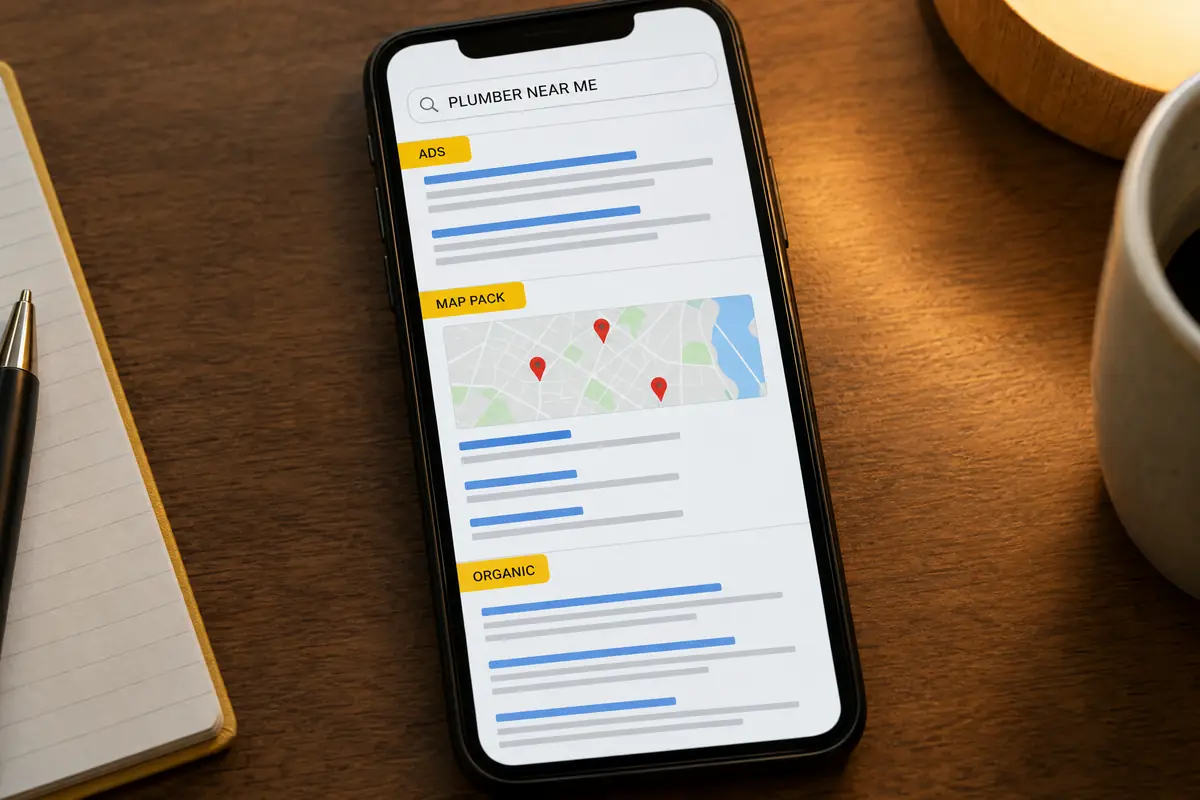
Search "plumber near me" or "dentist North Park" on your phone and Google shows a small map with pins and, under it, three business listings: name, star rating, hours, a call button, a directions button. That block is the map pack. People also call it the local pack or the 3-pack.
It is not the same thing as the organic results. The plain blue links below it are ranked separately, and a business can be in one and missing from the other. It is also not the top of the page. Regular Google Ads can sit above it, and in some trades Local Services Ads — the pay-per-lead listings with a Google badge — sit above it too. Depending on the search, the pack can show up right under the ads or further down among the organic links.
A customer with water on the floor does not read ten websites. They tap call on one of three.
How does Google decide who is in it?
Google publishes the answer. Its own help page on how local results are ranked says they are based mainly on three things: relevance, distance and prominence. It also says you cannot pay Google for a better local ranking. Everything that works pushes on one of those three. Here they are in owner language.
Relevance: do you match what was typed?
Google has to be sure you do what the person searched for. It reads your categories, services list, description, reviews and website. If a customer searches "tankless water heater install" and those words appear nowhere on your profile or site, Google has to guess. It usually guesses someone else.
Distance: how far are you from the person searching?
How far your business is from the searcher, or from the place they named in the search. It is the factor you control least: the same search typed in Carlsbad and in Chula Vista returns different businesses.
Prominence: how well known are you?
How much the rest of the world knows and talks about you. Google's page names reviews — how many and how positive — and how many websites link to your business. Links point at your website, so ordinary website SEO feeds the map pack too. Prominence is the slowest of the three to build and the hardest to fake.
That is the whole list. Any tactic someone sells you should map to one of those three. If it doesn't, ask what it actually does.
Why is San Diego its own problem?
Most map pack advice is written as if a "city" is one market. San Diego County isn't. It is big, it is spread out, and freeways and canyons cut it into pieces. Customers search from where they live, and distance is one of the three factors, so in practice the county behaves like several separate markets:
- Coastal North County — Oceanside, Carlsbad, Encinitas and the towns between them.
- Inland North County — Escondido, San Marcos, Vista, Poway.
- Central San Diego — the city itself: Clairemont, Kearny Mesa, North Park, Mission Valley, downtown and the neighbourhoods around them.
- East County — El Cajon, La Mesa, Santee and further east.
- South Bay — Chula Vista, National City and down to the border.
You compete in a radius, not countywide. A business verified in Kearny Mesa has a real shot at searches typed in Kearny Mesa, Clairemont and the neighbourhoods close by. Someone searching from Oceanside is mostly shown Oceanside-area businesses, however good the Kearny Mesa profile is. That is not a failure. It is how distance works. The goal is to be the obvious pick inside your radius first, then widen it with prominence.
The dense middle is the hardest. Central neighbourhoods like North Park or Kearny Mesa pack a lot of businesses into a small area, so more of them sit close to every searcher and the fight is decided on relevance and prominence. A business in a less crowded part of the county may face fewer close competitors.
Service-area businesses hide the address, but it still counts. If you go to your customers — plumbers, electricians, mobile detailers — and nobody comes to your address, Google's guidelines say to hide the address and set a service area instead. In our experience, the ranking still works from the verified address behind the scenes. Setting a service area that covers the whole county does not put you in the pack in Chula Vista if you are based in Poway.
You can't fake an address. The tempting move is a virtual office or a shipping-store mailbox in the part of town you want. Google's guidelines do not allow it: the profile has to be a real location where you operate. Profiles built that way get suspended, often right after they start working. The honest way into a second area is a real second location.

The plan, in order
Eight steps. The order matters. A lot of owners start at step six because someone sold them links, while step one is half-done.
1. A verified, complete Google Business Profile
Nothing ranks without a verified profile. Then fill in all of it: the name exactly as on your sign, address or service area, phone, hours, the services list, attributes, a real description, real photos. A lot of San Diego profiles are claimed and abandoned — one category, no services, three old photos. Finishing yours is the cheapest edge you will ever get. If you want it done by hand, our Google Business Profile setup is $750 once, per location, in 10 business days. Verification itself is Google's step and runs on Google's timeline.
2. The right primary category
Your primary category is one of the strongest relevance signals you set yourself. Pick the most specific one that describes your main business: "Plumber", not "Contractor"; "Roofing contractor", not "Construction company". Add secondary categories only for services you really do. A good way to check: search your main service from your own neighbourhood and look at what primary category the three businesses in the pack use. If they all use one and you use another, that is the first thing to test.
3. Reviews: a steady ask, every job, every reply
Reviews feed prominence, and they are what a customer reads before choosing between the three. The trick is a habit, not a burst. After every finished job, ask. Make it easy: a direct review link from your profile, a QR card left on the counter or handed over with the invoice, and one plain sentence you or your techs actually say, such as "If we did a good job, would you leave us a quick Google review? It helps a small shop more than you'd think." Send the link by text the same day.
Reply to every review, the good ones and the bad ones. Short, specific, signed. A calm reply to an angry one-star is read by every future customer who sees it.
Two hard lines. Never buy reviews, write them, or trade them. And never gate them — asking only happy customers, or routing unhappy ones somewhere else first. Google's policies prohibit both, and a profile caught doing either can lose reviews or be suspended.
4. A website page per core service, and for where you really are
Google reads the website linked from your profile. Give each core service its own page — "Water heater repair", "Drain cleaning", "Repiping" — not one page listing twelve services in a sentence. Name the area you actually operate from, with the same name, address and phone as the profile. If your shop is in El Cajon and you work across East County, say so. One honest page about a real area beats twenty thin ones. If you are not sure your site is pulling its weight, the sibling post on why a website doesn't show up on Google walks through the usual causes.
5. Citations: the same name, address and phone everywhere
A citation is any listing of your business name, address and phone (NAP) on another site: Bing Places, Apple Business Connect, Yelp, Facebook, Nextdoor, BBB, Angi, Houzz, Thumbtack and the rest. They need to match your Google profile exactly. An old address, a dead number, "Inc." on one listing and not another — each gives Google a reason to doubt which version is true. Fix the main directories first.
6. Local links and mentions that are real
Links from real local and industry sites build prominence, and you probably have more available than you think: your suppliers' "find an installer" pages, your trade association, the youth team you already sponsor, your local chamber of commerce, a neighbourhood news site that covered you. Ask for the link. Skip anything bought in bulk from strangers.
7. Photos and activity
Add real photos of real jobs, the van, the team. Post updates. Keep the hours right around holidays. Activity is not a magic ranking lever, but a stale profile tells the customer something, and a current one gives Google more to read.
8. Track it honestly
One search from your office desk tells you almost nothing, because rankings change block by block. Check from several points across your service area — say, Clairemont, La Mesa and the edge of where you would still drive. Then look at what matters more than position: in your profile's Performance view, count calls, direction requests and website clicks month over month. A rank that rises while calls stay flat is a number, not a result. If your profile is set up and still not showing, the sibling post Google Business Profile not ranking: 12 checks goes through it one item at a time.

What doesn't work, and what wastes money
- Keyword-stuffed business names. "Marrow Creek Plumbing – Best Emergency Plumber San Diego 24/7" is against Google's guidelines. Use the name on your sign. Stuffed names get reported and suspended.
- Fake listings at virtual offices. A mailbox in Carlsbad does not make you a Carlsbad business. It makes you a suspension waiting to happen.
- Review gating. Sending a "how did we do?" survey and only passing happy customers to Google is selective soliciting, and Google prohibits it.
- Buying reviews. Fake reviews get removed and can take the profile down with them.
- Mass auto-generated city pages. Forty copies of one page with the town name swapped, for places you don't serve, are thin content and do not help.
- Guaranteed-ranking offers. Google decides who is in the pack. Anyone who guarantees a spot is guessing, or about to do something on this list.
How long does it take?
Months, not weeks. Fixing a half-finished profile or a wrong category can show a change sooner, because you were giving Google wrong information and now you aren't. Reviews, citations, pages and links build up over months, and Google needs to see them hold before it moves you much.
A new business with few reviews usually wins a tight radius first — the blocks around its address — and widens as prominence grows. An established business with a neglected profile can sometimes move faster, because the prominence is already there. It depends on your trade, how crowded your part of the county is and who is already in the three. Nobody honest will give you a date.
When should you buy ads instead, or alongside?
Map pack work compounds, but it is slow. If you need the phone ringing next month, or want customers in a part of the county distance keeps you out of, ads are the honest tool: they show where you target from day one and stop when you stop paying. Local Services Ads, pay-per-lead, are another option in some trades. Plenty of businesses run both. We manage Google Ads from $1,500 a month on $1k–$3k of spend, which you pay to Google directly. Every price is on the pricing page.
Whatever brings the calls, answer them. A spot in the pack is wasted on a phone that goes to voicemail. If that is your bottleneck, our custom-build side makes sure every call the pack sends you gets picked up, qualified and booked.
What Haymaker does
We do the plan above for San Diego County small businesses, contractors and trades first. Two products, in order:
- Google Business Profile setup — $750 once, per location. Steps one and two, plus the review link, QR card and ask script, done by hand in 10 business days. Nothing renews.
- Local SEO Starter — $1,400 a month, month-to-month. A monthly review-ask campaign, a response to every review, the 50+ directory build-out, one new page a month and rank tracking on 10 keywords.
We are a new shop with no case studies yet, and we won't make any up. First cohort: ten spots, and the $750 setup is on us if you start a monthly plan in it. More on the local SEO in San Diego page.